Piston (reciprocating) compressors and rotary screw air compressors are two of the most popular compressor technologies available today. But do you know which one would be better suited for your specific needs and applications? Understanding the difference between piston and rotary screw air compressors and the capabilities of each technology is key. That’s why we’re covering the basics below!
What factors should I consider?
Initial and operating costs, energy efficiency, duty cycle, and service intervals are important factors to consider when determining whether your business will benefit most from a piston or a rotary screw compressor. Noise levels is an additional factor to take into consideration.
- Initial cost vs. operating costs. Budgeting for a compressor shouldn’t only include how much you pay for your compressor upfront; you also need to consider how much you’ll pay for your compressor in the long run (i.e. your overall operating costs). As much as 70-75% of a compressor’s lifetime operating costs are spent on energy usage, so keep that in mind when selecting a compressor technology. Pistons have a lower initial cost than screws, but screws cost much less to operate over time.
- Energy efficiency. If both a piston and a screw were running the same amount of hours, the screw compressor will be much more efficient and have lower operating costs than the piston over the lifetime of the compressor. When selecting a technology, ask yourself: Is the initial or lifetime cost more important to you and your business?
- Duty cycle. Because piston compressors are limited in their duty cycles, they’re ideal for applications with low duty cycle requirements and low daily running hours. Screw compressors, however, have long duty cycles. In fact, screws are engineered to run 100%, all day, every day!
- Service intervals. There are more moving parts in a piston compressor than in a screw, which results in increased machine wear and tear. Screw compressors don’t have as much wear; hence, they have reduced maintenance needs. But keep in mind that it’s important to keep any type of compressor on a consistent maintenance schedule! This will help ensure machine efficiency and optimal system performance.
- Noise levels. Piston compressors are loud – especially in comparison to screw technology. If you’re looking for a lower-noise machine or a low noise level is required, you may want to consider a screw compressor.
Piston vs. rotary screw compressor: a side-by-side comparison
To make the right choice between a piston and a rotary screw compressor, it helps to see how the two technologies stack up directly across the factors that matter most to your operation:
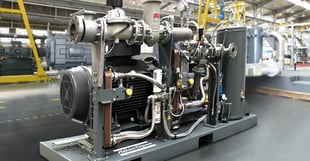
How they work: A piston compressor uses a reciprocating piston driven by a crankshaft to draw air into a cylinder and compress it with each stroke. It is a well-established mechanical design that has been used in industry for well over a century. A rotary screw compressor uses two interlocking helical rotors that continuously trap and compress air as they rotate, delivering a smooth, continuous flow of compressed air with no reciprocating motion.
Output consistency: The reciprocating action of a piston compressor produces compressed air in pulses rather than a continuous stream. This can cause pressure fluctuations in the system, which may affect the performance of sensitive downstream equipment. A rotary screw compressor delivers a steady, continuous flow of compressed air, resulting in more stable system pressure and more consistent performance for tools and processes.
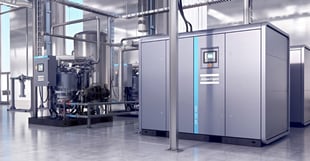
Size and footprint: Piston compressors tend to have a larger footprint relative to their output compared to rotary screw compressors. Rotary screw compressors are designed to be compact and space-efficient, making them a better fit for facilities where floor space is at a premium.
Application fit: Piston compressors are well suited for intermittent use, lower CFM requirements, and applications where upfront cost is the primary concern. Rotary screw compressors are the preferred choice for continuous or heavy-duty operations, higher CFM demands, and facilities where energy efficiency, noise levels, and long-term operating costs are the priority.
The recap
Piston air compressors a great option as an entry level compressor, but it's common for facilities outgrow the unit. If you need a consistent and or increased flow (CFM) and are looking for something that is compact, efficient, reliable and quiet, going with a rotary screw would be a great option. It’s quite normal for a company to start out with limited need for compressed air, but as production and customer demand increases, so does the need for increased output and the need for a larger compressor that can adequately handle the demand and increased duty cycle!
Still struggling with which technology is right for you? Our compressed air experts are always available to talk you through the decision! Give us a shout at www.atlascopco.com/air-usa!
Frequently asked questions



 5 min
5 min