For PET bottling plants, compressed air is a critical production component that directly impacts bottle quality, production speed, operational efficiency, and uptime.
One of the most important decisions manufacturers face when upgrading or expanding their PET blowing operation is choosing the best solution. The right solution depends on production capacity, facility infrastructure, operating costs, energy goals, and long-term scalability.
Today, many PET bottling operations are moving toward modern hybrid high-pressure compressor technologies because they reduce installation complexity, simplify maintenance, eliminate cooling water requirements, and improve operational flexibility.
Solutions like the ZP and ZD from Atlas Copco are designed specifically to help PET manufacturers achieve reliable high-pressure performance while reducing energy consumption and protecting product quality with oil-free air.
PET bottle production requires reliable high-pressure oil-free air
PET bottle blowing applications require consistent high-pressure compressed air to shape bottles quickly and accurately during production. Because compressed air comes into direct or indirect contact with beverage packaging, air quality is extremely important.
Oil contamination can lead to packaging defects, production downtime, increased maintenance, and even potential product quality concerns that impact brand reputation and compliance requirements. This is why oil-free compression technology is so important in beverage and food manufacturing applications.
Oil-free compressors help protect beverage quality while supporting stable, consistent production performance. For PET bottling facilities focused on maintaining both operational efficiency and product integrity, clean compressed air is essential.
Air-cooled compressors reduce installation complexity
One of the biggest advantages of air-cooled high-pressure compressors is simplified installation.
Traditional water-cooled systems often require cooling towers, water treatment systems, additional piping, and ongoing cooling system maintenance. That infrastructure can increase both upfront installation costs and long-term operational complexity.
Air-cooled systems eliminate many of those requirements, making them especially attractive for facilities looking to simplify deployment or expand production quickly.
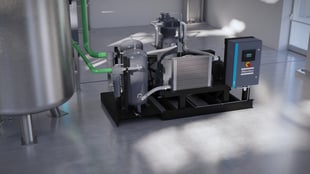
The Atlas Copco ZP is designed as a plug-and-play solution for PET bottling operations that want a compact, easier-to-install high-pressure compressor package. Because the ZP is air-cooled, facilities can avoid the complexity and expense associated with cooling water infrastructure while benefiting from faster installation, reduced facility modifications, and simplified maintenance.
For growing PET bottling operations, reducing installation complexity can help accelerate production timelines and lower total project costs.
Plug-and-play systems help PET plants scale faster
Many PET manufacturers are expanding production to meet increasing beverage demand. As production lines grow, facilities need compressed air systems that can scale efficiently without creating major operational disruption.
Plug-and-play compressor systems are becoming increasingly popular because they reduce commissioning time and simplify deployment.
Atlas Copco’s ZP compressor package is specifically designed to support these operational needs.
Key benefits include:
- Compact footprint
- Easy installation
- Integrated connectivity
- Reliable high-pressure performance up to 580 PSIG
- Simplified service access
While air-cooled systems offer significant simplicity advantages, water-cooled compressors may still be appropriate for certain large-scale or specialized operations.
Facilities with existing cooling water infrastructure, extremely high ambient temperatures, continuous heavy production loads, or centralized utility systems may benefit from water-cooled designs depending on their operating environment.
When evaluating compressor technology, manufacturers should consider the total lifecycle cost of ownership, not just the initial equipment investment.
Hybrid compression technology can improve energy efficiency in high pressure applications
Energy costs remain one of the largest operating expenses in compressed air systems, especially in high-pressure PET applications where bottle blowing operations require substantial compressed air demand.
The Atlas Copco ZD uses advanced hybrid 4-stage compression technology designed to improve efficiency in demanding high-pressure applications. The ZD supports higher flow ranges and pressures up to 1450 PSIG while helping facilities reduce energy consumption and improve operational performance.
By optimizing the compression process across multiple stages, hybrid systems can help:
- Reduce energy consumption
- Improve operational efficiency
- Lower lifecycle operating costs
- Deliver more stable performance
- Support continuous production environments
For facilities operating multiple PET blowing lines, even modest efficiency improvements can translate into significant long-term energy savings.
Oil-free air helps protect beverage quality and brand reputation
In beverage manufacturing, compressed air quality directly impacts production integrity. Oil contamination in compressed air systems can create risks that go beyond equipment performance and maintenance.
Contaminated air can potentially affect beverage safety, packaging quality, product consistency, customer trust, and compliance standards. That is why oil-free compressed air technology is especially important in applications such as bottled water, soft drinks, dairy beverages, juice production, and food packaging.
The “Pure air, pure performance” message reflects the growing focus manufacturers place on protecting both product quality and operational reliability.
Connectivity and monitoring improve operational visibility
Modern PET production facilities increasingly rely on connected equipment and operational monitoring to improve efficiency and reduce downtime.
Smart compressor connectivity allows operators to monitor system performance, track energy usage, identify maintenance needs earlier, and improve overall system efficiency.
The Atlas Copco ZP includes connectivity features that support operational visibility and proactive maintenance planning. Connected compressor systems help operators respond faster to potential issues and reduce unplanned production interruptions.
For facilities managing high production volumes, improved operational visibility can play a major role in maintaining uptime and production consistency.
Service support is critical for high pressure applications
PET bottling operations depend on reliable compressed air availability.
Compressor downtime can quickly impact production schedules, fulfillment timelines, and operational profitability.
Strong service support is essential when evaluating high-pressure compressor solutions.
Atlas Copco’s nationwide service network helps support:
- Faster service response
- Maintenance support
- Parts availability
- System optimization
- Long-term operational reliability
For manufacturers operating continuous production environments, reliable service access is often as important as equipment performance itself.
Choosing the right high pressure compressor depends on your production goals
Every PET bottling operation has unique production requirements. When evaluating high-pressure compressor solutions, facilities should consider current production capacity, future expansion plans, energy costs, installation requirements, maintenance capabilities, and air quality needs.
Manufacturers should ask:
- Is the current compressor system limiting production?
- Are energy costs increasing?
- Is downtime becoming more frequent?
- Is expansion planned in the near future?
- Are air quality concerns becoming more important?
The right compressor solution should support both immediate operational needs and long-term growth goals.
Modern high pressure compressor solutions support long-term operational efficiency
Today’s PET bottling plants require more than compressed air. They need reliability, efficiency, scalability, connectivity, and dependable service support.
Advanced high-pressure compressor technologies are helping manufacturers reduce complexity while improving operational performance. Whether a facility needs a compact plug-and-play solution like the Atlas Copco ZP or advanced hybrid high-pressure performance like the ZD, modern compressor technology can help support efficient and reliable PET bottle production.
As beverage manufacturing continues to evolve, compressed air systems will remain a critical part of maintaining production quality, operational efficiency, and long-term competitiveness.
FAQs



 5 min
5 min