

Why is hydrogen difficult to compress?
December 5, 2024
 5 min
5 min

As we approach the end of the year, the days grow shorter, and the nights become colder. We build fires, wear more layers and crank up the heater to protect ourselves against the bracing temperatures. But sometimes, extreme cold can lead to serious issues, both for people and structures. Houses can be damaged by heavy snow, icy branches that snap under their own weight and burst pipes. Frozen temperatures can spell trouble for many structures, and this holds true with refrigerant dryers. With the help of hot gas bypass, you can keep your dryer running at the optimal temperature without risking the health of your system.
In compressed air systems, hot gas bypass plays a critical role in maintaining stable operating conditions, especially when demand fluctuates or when ambient temperatures drop significantly.
The refrigeration circuit in a refrigerant dryer is sized to cool the full inlet capacity to a certain temperature. If for some reason there is only a partial load on the dryer, the refrigerant circuit could over-cool the air, which would then cause the water in the air to not just condense, but also freeze. If water were to freeze within the heat exchanger the air flow can be blocked and expansion that occurs during ice formation can crack the heat exchanger.
This is where hot gas bypass becomes essential, as it prevents excessive cooling during low load conditions and protects internal components from freezing damage.
The hot gas bypass is a valve that automatically regulates the cooling temperature in the dryer exchanger based on the refrigerant pressure. The pressure measured after the heat exchanger directly correlates to the temperature in the system. A low pressure means there will be a low temperature.
In practical terms, hot gas bypass ensures that the refrigerant dryer does not cool beyond the required dew point, even when airflow demand is reduced.
When a dryer is only partially loaded, there is a lower pressure in the system. As the pressure in the refrigerant circuit decreases, the hot gas bypass valve opens, allowing some of the refrigerant to circumvent the heat exchanger, eliminating the problem of over-cooling.
By introducing controlled amounts of warm refrigerant gas back into the system, hot gas bypass stabilizes the temperature and maintains consistent dryer performance.
It’s important to select a hot gas bypass that is able to fully open and close based on the pressure input. Hot gas bypass valves with limited opening capability are less likely to prevent freezing when the incoming load is especially low.
An effective hot gas bypass system should respond accurately to pressure changes and adjust continuously, ensuring precise temperature control across varying load conditions.
The control of the opening of the valve has to be a function of the measured pressure and the valve position needs to be consistent. This is an absolute requirement for the dryer to maintain a steady output pressure dewpoint. A dryer should be fit for life, meaning that all components have to be reliable over many years of operation, including the hot gas bypass.
In long-term operation, a well-designed hot gas bypass contributes to system reliability by reducing thermal stress, minimizing wear, and maintaining consistent dew point performance.
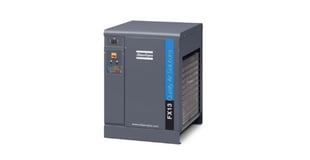
You may not be able to escape the elements this winter, but your refrigerant dryer shouldn’t be left out in the cold. By ensuring your compressed air dryer utilizes hot gas bypass, you can prevent harmful over-cooling. Talk with an Atlas Copco specialist today about our range of refrigerant dryers and how you can use hot gas bypass to keep your compressed air system healthy.
Integrating hot gas bypass into your refrigerant dryer setup is a practical step to ensure stable operation, protect critical components, and maintain consistent air quality across different operating conditions.